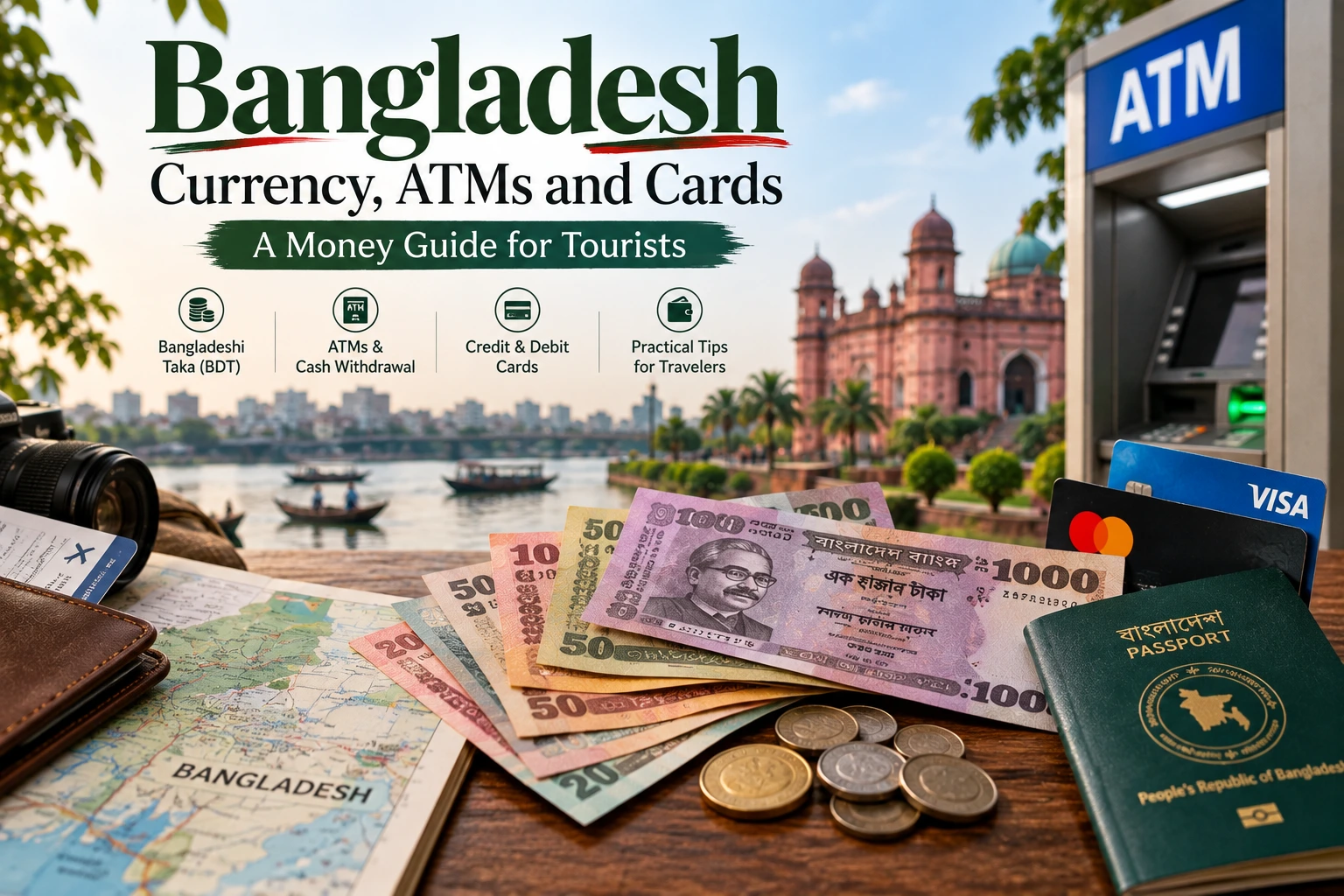
The first few hours in Bangladesh can make money feel more complicated than it really is.
You leave Dhaka Airport with a wallet full of unfamiliar notes. Your hotel accepts a credit card, but the rickshaw puller outside accepts only cash. A restaurant displays a mobile-payment sign, yet the app requires a local account. An ATM recognizes your international card, but your bank may add one fee while the machine adds another.
None of these situations is unusual.
Bangladesh has a growing digital-payment system, especially in major cities, but cash remains essential for everyday travel. International cards work in many hotels, established restaurants, supermarkets and larger businesses. ATMs accepting foreign cards are available in urban areas, although availability becomes less dependable in smaller towns and rural destinations.
The best strategy for most foreign visitors is not to choose between cash and cards. It is to carry both, with a second card and a small emergency reserve stored separately.
Quick answer: The official Bangladesh currency is the Bangladeshi taka, identified by the international code BDT and commonly written with the symbol ৳ or the abbreviation Tk. Foreign visitors should use taka for ordinary purchases, carry cash for local transport and small businesses, and keep an international debit or credit card for hotels, established restaurants and ATM withdrawals.
This guide explains how the Bangladesh currency works, where to exchange money, how to use ATMs safely, when credit cards are accepted and how to avoid common payment problems.
Bangladesh Currency at a Glance
| Money question | Practical answer |
| Official currency | Bangladeshi taka |
| International currency code | BDT |
| Common symbol | ৳ |
| Common local abbreviation | Tk |
| Subdivision | One taka equals 100 poisha |
| Best everyday payment method | Bangladeshi taka in cash |
| Card availability | Best in Dhaka and other major cities |
| ATM availability | Commoner in urban areas; fewer in rural regions |
| Common foreign currency for exchange | US dollars are widely recognized |
| Best visitor strategy | Cash, primary card and backup card |
| Exchange-rate source | Bangladesh Bank or a trusted live converter |
| Mobile payments | Common locally but not always accessible to short-term foreign visitors |
Bangladesh Bank explains that the taka’s exchange rate against the US dollar is influenced by interbank transactions and market demand and supply. The amount offered to an individual traveler may differ from the interbank rate because banks, ATMs and exchange businesses can add their own margin or fee.
What Is the Currency of Bangladesh?
The official currency of Bangladesh is the Bangladeshi taka.
Its ISO currency code is BDT. Within Bangladesh, prices may be written using:
- ৳
- Tk
- BDT
- The Bangla word টাকা
For example, a price may appear as ৳500, Tk 500 or BDT 500. These expressions refer to the same amount.
One taka is technically divided into 100 poisha, although international travelers are unlikely to use poisha during ordinary purchases.
How is taka pronounced?
“Taka” is generally pronounced close to tah-kah.
The word is used in both singular and plural contexts in everyday English. A person may say “one hundred taka” rather than “one hundred takas.”
Which Bangladeshi banknotes will tourists see?
Travelers will encounter notes in several values. Commonly used denominations include:
- Tk 10
- Tk 20
- Tk 50
- Tk 100
- Tk 200
- Tk 500
- Tk 1,000
Smaller notes and coins also circulate. Designs can differ because older and newer series may remain in use together.
Bangladesh Bank publishes information about official notes, coins and banknote security features. Its current material includes redesigned banknotes featuring historic and archaeological structures. bb.og.bd
Why are small notes important?
A Tk 1,000 note is useful at a hotel or established shop, but it may be inconvenient when paying for:
- Rickshaws
- Tea
- Bottled water
- Market purchases
- Small entrance charges
- Tips
- Short local journeys
When withdrawing or exchanging money, ask for a mixture of denominations. Do not wait until the end of a short rickshaw ride to discover that neither person has change.
Hotels, supermarkets and established restaurants can be useful places to break a large note after making a legitimate purchase.
Is Bangladesh a Cash-Based Country?
Bangladesh is no longer entirely cash-based, but tourists should still expect to use cash frequently.
Digital payments have expanded quickly. Urban residents regularly use cards, bank transfers, QR payments and mobile financial services. However, the payment method popular with local residents may not be available to a short-term visitor.
A market seller might accept a local mobile payment but not an overseas Visa card. A restaurant may accept cards while its delivery rider needs cash. A hotel can process an international payment, while a rural boat operator may have no card facility at all.
Where cash is normally needed
Carry taka for:
- Cycle rickshaws
- CNG auto-rickshaws
- Small local restaurants
- Street food
- Traditional markets
- Small shops
- Local guides and porters
- Rural transportation
- Village purchases
- Tips and incidental payments
- Some heritage and attraction tickets
A visitor joining a Dhaka Food Tour may encounter both established restaurants and smaller local vendors. Carrying smaller taka notes makes tasting stops and personal purchases easier without turning the food experience into a search for change.
Where international cards are more likely to work
Cards are more commonly accepted at:
- International and upscale hotels
- Established city hotels
- Larger restaurants
- Supermarkets
- Shopping centres
- Airline offices and websites
- Established travel companies
- Some hospitals and private medical facilities
- Larger retail businesses
Card acceptance does not guarantee that every foreign-issued card will work. The merchant’s terminal, local bank, international card network and your home bank all influence the result.
Can Tourists Use Credit Cards in Bangladesh?
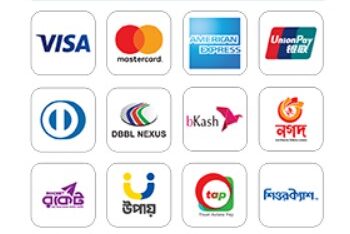
Yes, international credit and debit cards can be used in Bangladesh, particularly in Dhaka and other major urban centres. Visa and Mastercard are generally the most practical networks for foreign travelers.
However, the US Department of State notes that credit-card acceptance varies even in major cities and may be limited in smaller towns and rural regions. It recommends being prepared to pay in cash.
When should you use a card?
Cards are useful for:
- Hotel bills
- Higher-value restaurant meals
- Domestic flights
- Established tour bookings
- Supermarket purchases
- Emergency medical expenses
- Reducing the amount of cash carried
Before relying on a card, ask whether the business accepts your specific network.
Keep a backup card
Do not carry only one payment card.
A card can fail because:
- Your bank blocks an overseas transaction.
- The merchant’s terminal loses connectivity.
- The local bank rejects the network.
- The magnetic strip or chip cannot be read.
- The ATM is temporarily unavailable.
- A daily withdrawal limit has been reached.
- Your bank detects unusual activity.
- The card is lost, retained or damaged.
Keep the backup card separately from the primary wallet. If both cards are stored together, one lost bag removes both options.
Notify your bank before departure
Some banks no longer require formal travel notifications, but travelers should still check:
- Whether Bangladesh transactions are permitted
- International ATM fees
- Foreign-transaction fees
- Daily withdrawal limits
- Card-replacement procedures
- Emergency contact numbers
- Whether app-based transaction approval will work abroad
Make sure your banking app and authentication number remain accessible in Bangladesh.
Are Contactless and Mobile Payments Available?
Contactless card terminals are present in some hotels, restaurants and larger shops, but visitors should not assume that every card terminal supports tap-to-pay.
A physical card and PIN may still be required.
Using bKash or Nagad as a tourist
Mobile financial services such as bKash and Nagad are deeply integrated into everyday Bangladeshi commerce. Travelers will see payment numbers and QR codes at shops, restaurants and other businesses.
Short-term foreign visitors should not assume they can immediately create and fund a local mobile wallet. Registration, identification, mobile-number ownership and account requirements may apply.
Treat mobile payments as a possible convenience only after confirming that you are legitimately eligible to use the service. They should not replace cash and an international card in your travel plan.
Can tourists use Apple Pay or Google Pay?
Availability depends on the visitor’s card issuer, device wallet and the merchant’s terminal. Even if a card is loaded into Apple Pay or Google Pay, the local terminal may not process the transaction.
Carry the physical card and some cash.
Are ATMs Available in Bangladesh?
ATMs are available in Dhaka and most larger urban areas. International cards can work, but acceptance, withdrawal limits and fees vary by bank and machine.
UK government travel guidance says ATMs are available in most urban areas and accept UK cards, while rural areas have fewer machines. The US Department of State similarly says Bangladesh has ATMs that accept US-issued bankcards but warns that fees may be high. Bangladesh travel advice
Where should tourists use an ATM?
Prefer machines located:
- Inside a bank branch
- In an airport banking area
- Inside a reputable shopping centre
- In a major hotel
- In a well-lit commercial building
- In an area monitored by security personnel
An indoor or bank-connected ATM is preferable because assistance may be available if the machine retains the card or fails to dispense the correct amount.
How to withdraw money safely
Before inserting the card:
- Check whether the card slot looks loose or altered.
- Look for unusual attachments around the keypad.
- Avoid accepting help from a stranger.
- Cover the keypad when entering the PIN.
- Put the money and card away before leaving.
- Keep the receipt only if you need it.
- Check the banking app for the completed transaction.
- Report any incorrect or suspicious transaction immediately.
Canadian travel guidance warns that credit-card and ATM fraud occurs, particularly in Dhaka. It recommends using ATMs in public places or inside banks or businesses, checking card readers and monitoring account statements.
What fees can an ATM charge?
An international cash withdrawal can involve several charges:
- Local ATM fee
- Home-bank withdrawal fee
- Foreign-transaction fee
- Card-network conversion margin
- Unfavorable currency conversion
The screen should show any local machine charge before confirmation, although your home bank’s fee may appear only after the transaction.
Withdrawing many small amounts can multiply fixed charges. At the same time, withdrawing excessive cash creates a security risk. Choose a sensible middle ground based on the next stage of the journey.
What if the ATM offers conversion into US dollars?
Some ATMs or payment terminals may offer to convert the transaction into your home currency. This is known as dynamic currency conversion.
The offered conversion may include an unfavorable rate or additional margin. Selecting payment in Bangladeshi taka or BDT normally allows your own card network or bank to perform the conversion.
Read the screen carefully. Do not press a button simply because the amount is shown in familiar US dollars.
What if an ATM retains the card?
If a machine keeps your card:
- Do not leave immediately if the ATM is attached to an open bank.
- Contact bank staff.
- Record the bank name and ATM location.
- Freeze the card through your banking app.
- Contact the issuing bank.
- Use the backup card if recovery is not immediate.
Avoid repeated attempts if a machine rejects the card. Try an ATM operated by another established bank.
Where Should Tourists Exchange Money in Bangladesh?
Foreign currency should be exchanged through an authorized bank or legitimate money-changing business.
Avoid informal street exchanges, even when the offered rate appears better. An unofficial transaction can expose the traveler to counterfeit notes, inaccurate counting or legal problems.
Exchanging money at Dhaka Airport
Exchanging a limited amount at Hazrat Shahjalal International Airport can be practical for:
- Transportation
- Food and water
- Initial tips
- Small purchases
- Backup funds before reaching the hotel
Airport exchange rates may differ from rates elsewhere. Exchange enough for the first stage of the journey, then compare an authorized city option if additional cash is required.
Exchanging money at a bank
Banks provide a formal exchange process, but operating hours, identification requirements and waiting times may make them less convenient than an authorized exchange counter.
Bring your passport and ask whether a receipt will be provided.
Exchanging money at an authorized money changer
Authorized exchange businesses are available in parts of Dhaka frequented by international visitors. Before completing the transaction:
- Confirm the displayed rate.
- Ask whether there is a separate commission.
- Calculate the expected total.
- Count the taka before leaving.
- Request a receipt.
- Keep the receipt until departure.
- Avoid exposing your full travel funds publicly.
What condition should foreign banknotes be in?
Bring clean, undamaged foreign notes where possible. Exchange businesses may inspect notes and can reject currency that is torn, heavily marked, taped or badly worn.
Do not carry the complete travel fund in one envelope. Divide it between secure locations.
How Should Tourists Check the Exchange Rate?
Exchange rates move. An article that permanently states one USD-to-BDT value will become outdated and can mislead travelers.
Use a current source such as:
- Bangladesh Bank
- Your issuing bank
- A recognized currency converter
- The authorized exchange provider completing the transaction
Bangladesh Bank’s published rate is based on the foreign-exchange market and is a useful reference, but it may not equal the retail rate available from an ATM, card issuer or exchange counter.
Why does the amount differ from Google?
The rate displayed in a search result or converter may be a market or mid-market reference. The amount received by the traveler can be lower because of:
- Exchange margins
- Bank charges
- Card-network fees
- ATM fees
- Cash-handling costs
- Dynamic currency conversion
- Weekend or settlement timing
Compare the final amount, not only the headline rate.
Should this page display a live rate?
A live exchange widget can be useful if it is technically reliable and clearly labeled. It should show:
- The data provider
- The time of the last update
- Whether the rate is mid-market or retail
- A disclaimer that banks and exchanges may offer a different amount
If Bangladesh Explore cannot maintain the widget accurately, link to Bangladesh Bank instead of embedding a stale number.
Can Tourists Pay in US Dollars?
Bangladeshi taka is the correct currency for ordinary payments.
A hotel or tourism provider may quote an international service in US dollars, but local restaurants, rickshaws, markets and small shops should be expected to request taka.
Do not assume that displaying US dollars will simplify an everyday transaction. It can create uncertainty about the conversion rate and change.
Exchange or withdraw taka through legitimate channels.
How Much Cash Should a Tourist Carry?
There is no universal amount because a traveler’s need depends on destination, accommodation, transportation and activities.
This page should not calculate the complete daily or trip budget. That intent belongs to the dedicated Bangladesh travel cost article.
A practical cash decision should consider:
- Whether the hotel is prepaid
- Whether transportation is prepaid
- Availability of ATMs at the next destination
- Card acceptance at the accommodation
- Expected market or rural purchases
- Emergency transportation
- Length of time outside a major city
- ATM limits and fees
Carry enough taka to complete the current day and manage an unexpected transportation problem, but not so much that losing the wallet would threaten the entire journey.
Divide the money
Keep funds in at least two secure places:
- Everyday wallet
- Concealed backup location
- Hotel safe, where appropriate
- Separate emergency card holder
Do not keep the passport, both cards and all cash in the same bag.
Money Planning for Dhaka
Dhaka provides the country’s widest access to ATMs, banks, card facilities and authorized exchange services. Even so, smaller transactions remain cash-oriented.
During a Discover Dhaka City experience, visitors may move between museums, heritage areas, riverfront neighborhoods, local restaurants and rickshaw routes. One payment method may not work at every stop.
A useful Dhaka wallet contains:
- Small notes for local transportation
- Medium notes for meals and tickets
- One working card
- A small emergency cash reserve
- The hotel address
- Bank and card-emergency numbers
Avoid counting a large amount of money in a crowded public place.
Money Planning for Old Dhaka and Local Markets
Old Dhaka rewards visitors with Mughal-era sites, narrow lanes, river commerce, family-run shops and traditional food. It is not an environment where a foreign visitor should depend entirely on a card.
For an Old Dhaka Tour, cash is useful for:
- Rickshaw rides
- Tea and snacks
- Market purchases
- Small restaurants
- Tips
- Personal purchases not included in the tour
Keep the wallet secure and accessible without repeatedly opening a larger bag.
If a merchant does not have change, do not turn the interaction into a confrontation. Use a smaller note or complete the purchase somewhere better equipped to accept the denomination.
Money Planning Outside Dhaka
ATM and card availability decreases outside major commercial centres. Before leaving for a rural or nature-focused journey, withdraw or exchange a sensible amount in the city.
Sreemangal and Sylhet
Sylhet has banks and urban ATM facilities, while tea-estate areas, villages and smaller stops may depend more heavily on cash.
Travelers joining a Sreemangal and Sylhet Tour should confirm which meals, tickets and transfers are included, then carry taka for personal purchases and local tips.
The Sundarbans and Bagerhat
Remote river travel requires more preparation. Once a boat journey has started, finding a compatible ATM is not a realistic backup plan.
Before a Sundarbans and Bagerhat Tour, clarify:
- Included meals
- Boat costs
- Entrance permissions
- Guide and crew services
- Accommodation
- Transportation
- Expected tips
- Emergency cash needs
Do not carry the full amount in an exposed daypack.
North Bengal and heritage routes
Major cities such as Rajshahi and Rangpur offer banking facilities, but archaeological sites, villages and smaller roadside businesses may require cash.
Withdraw money before beginning a long rural day rather than assuming the next heritage stop will have an ATM.
How to Avoid Card and Money Fraud
Most transactions are straightforward, but basic precautions matter.
Protect the card
- Do not allow the card to disappear into another room.
- Watch the terminal where possible.
- Cover the PIN.
- Decline help from strangers at an ATM.
- Enable transaction notifications.
- Review banking activity daily.
- Freeze a missing card immediately.
- Retain only necessary receipts.
- Do not send a full card photograph through messaging apps.
Confirm the amount
Bangladeshi prices can use commas according to the South Asian numbering system. For example:
- 1,000 = one thousand
- 10,000 = ten thousand
- 1,00,000 = one lakh
- 10,00,000 = ten lakh
Check the terminal or invoice carefully before entering a PIN.
Be careful with card copies
A hotel may need identification or a payment authorization, but a business should not casually photograph both sides of a card. Ask why information is required and how it will be protected.
Never share a one-time password with a driver, guide, hotel employee or anyone claiming to assist with a transaction.
Check returned change
Count change calmly before leaving. Mistakes can happen without being deliberate, particularly in a busy market or restaurant.
Learn the general color and value of the banknotes, but rely on the printed denomination rather than color alone because different note series may circulate.
Bringing Currency Into or Out of Bangladesh
Bangladesh has declaration rules for foreign and local currency. Travelers carrying a significant amount must check the current requirements before departure.
Australian travel guidance states that amounts above US$5,000 must be declared when entering or leaving Bangladesh and says this applies to all forms of currency. Bangladesh Customs also publishes currency regulations concerning foreign travelers and declaration requirements.
Rules may change, and the treatment of cash, instruments and Bangladeshi taka can differ. Before traveling with a large amount:
- Check Bangladesh Customs.
- Confirm requirements with the airline or embassy.
- Complete the appropriate declaration.
- Retain stamped documentation.
- Keep exchange receipts.
- Do not divide money between companions to avoid a declaration.
This article provides travel-planning information, not customs or financial legal advice.
What to Do If Your Card Does Not Work
A declined transaction is not automatically evidence that the card has been blocked permanently.
Try the following:
- Check the banking app for an alert.
- Confirm that international transactions are enabled.
- Ask the merchant to retry once.
- Try chip and PIN instead of contactless.
- Use the backup card.
- Contact the issuing bank.
- Pay in cash if the transaction is legitimate.
- Avoid repeated attempts across multiple suspicious terminals.
If a hotel has already placed a deposit or authorization hold, ask before using another card. Multiple holds can temporarily reduce available credit.
What to Do If You Lose Your Wallet
Act quickly:
- Freeze or cancel the missing cards.
- Review recent transactions.
- Inform the hotel or guide.
- Report theft to the police when necessary.
- Contact the travel insurer.
- Access the separate emergency reserve.
- Contact the embassy if identification was lost.
- Change passwords if an unlocked phone was also taken.
Keep digital copies of essential documents in secure storage. Do not store unprotected card images alongside passport copies.
Tipping in Bangladesh
Tipping is appreciated in tourism and hospitality but does not follow one universal percentage.
Travelers may choose to tip:
- Guides
- Drivers
- Porters
- Boat crew
- Hotel staff
- Restaurant staff when a service charge is not already included
Confirm whether a service charge appears on the bill. Give a tip directly to the intended person where appropriate.
This article should not publish mandatory tipping amounts unless Bangladesh Explore has a transparent, current tipping policy. The value of money changes, and a rigid table can quickly become outdated.
A Practical Money Setup for Foreign Visitors
A balanced setup is more reliable than depending on one payment method.
Before leaving the hotel each day, consider carrying:
- A working international card
- A limited amount of taka
- Small denominations
- A phone with banking access
- The issuing bank’s emergency number
- A backup card stored separately
- An emergency reserve
Before leaving Dhaka for a smaller destination:
- Confirm ATM availability.
- Ask whether the hotel accepts cards.
- Clarify what the tour includes.
- Withdraw cash from a secure urban ATM.
- Divide the funds.
- Keep exchange and ATM receipts.
- Avoid relying entirely on mobile payment.
The goal is not to carry as much money as possible. It is to maintain more than one safe way to pay.
Frequently Asked Questions
What is the currency of Bangladesh?
The official Bangladesh currency is the Bangladeshi taka. Its international currency code is BDT, and prices may use the symbol ৳ or the abbreviation Tk.
Can I use US dollars in Bangladesh?
US dollars can be exchanged through authorized providers and may be used for certain internationally priced services. Everyday purchases should normally be paid in Bangladeshi taka.
Are credit cards accepted in Bangladesh?
International cards are accepted at many hotels, larger restaurants, supermarkets and established businesses in major cities. Acceptance is less dependable in smaller towns and rural areas, so travelers should carry cash.
Do ATMs in Bangladesh accept American cards?
Some Bangladeshi ATMs accept US-issued cards, particularly in major cities. Fees, limits and network acceptance vary. Use an ATM inside a bank or secure commercial building when possible.
Are ATMs widely available outside Dhaka?
ATMs are available in other cities, but rural areas have fewer machines. Withdraw an appropriate amount before traveling to remote destinations.
Is Visa or Mastercard better in Bangladesh?
Both networks can work, but acceptance depends on the local bank and merchant. Carrying cards from two different networks or issuers provides a useful backup.
Can I use Apple Pay or Google Pay in Bangladesh?
Some modern terminals may support contactless payment, but availability is inconsistent. Carry the physical card and Bangladeshi cash.
Can a tourist open a bKash account?
Eligibility and identification requirements apply to mobile financial accounts. Short-term visitors should not plan their trip around opening a local wallet unless the provider confirms that they qualify.
Where should I exchange money in Dhaka?
Use an authorized bank or licensed money changer. Airport exchange services can be useful for initial expenses. Confirm the rate, fees and final amount before completing the transaction.
Should I exchange all my money at Dhaka Airport?
Usually, there is no need to exchange the complete travel fund immediately. Obtain enough taka for arrival and initial expenses, then compare authorized options if more cash is needed.
Should I choose BDT or USD at an ATM?
When an ATM offers a choice, selecting BDT generally allows your bank or card network to perform the conversion. Review the rate and fees before confirming.
How can I avoid ATM fraud in Bangladesh?
Use secure indoor ATMs, inspect the card reader, cover the PIN, refuse help from strangers and monitor account transactions. Canadian travel guidance specifically warns that ATM and card fraud occurs in Bangladesh. travel.gc.ca
How much cash should I carry in Bangladesh?
Carry enough for daily small purchases, transportation and an emergency, but avoid carrying the complete trip fund. Full daily and total-trip calculations belong on the Bangladesh travel-cost page.
Do I need to declare money when entering Bangladesh?
Declaration requirements apply above certain thresholds. Australian guidance currently states that amounts over US$5,000 must be declared, but travelers should verify the latest rules directly with Bangladesh Customs before departure.